White Women in the Indian Imagination: Alexandra Delaney


An interesting post. Many things the writer says are true including the Indian male gaze but she completely bypasses that such behaviour is more than a local cultural, social or religious product, that globalisation and the free market have actually underscored even more, the idea of Indianness and ‘the other’; that the notion of feminism is deeply entrenched in the Indian imagination, male or female, as a white, Western concept of disregard, disrespect and disruption (because the original movement never considered non-Western, coloured women and their environments, still does not). The sustained portrayal of Caucasian women as loose and easy is a result of all the above, unfortunately.
….maybe this calls for a post of my own because it is beyond the simplistic discourse that Ms Delaney presents. It is a brave post anyway.

Nivedita Menon's avatarKAFILA - COLLECTIVE EXPLORATIONS SINCE 2006

This is a guest post by ALEXANDRA DELANEY: 

“Yeah, Indian guys think white girls are easy”, a British-born Indian remarked nonchalantly to me this week. Normally I’d be shocked by such gross racial stereotyping (of Indians) but in this case I’m inclined to agree. Not because Caucasian women by their very skin colour or cultural preferences are any more promiscuous than their South Asian sisters, but because of their sustained portrayal as loose and morally deficient. The image of the sexually liberated and ‘easy’ white woman runs deep in the Indian imagination, a perception which is drip-fed by the country’s all-pervading mainstream media.

The brutal rape and murder of an Indian student in New Delhi last December followed by numerous sexual attacks on foreign women has sparked international outrage. This year alone, a Chinese woman was date-raped in New Delhi, a Korean woman was raped after being drugged in Bhopal…

View original post 1,064 more words

Three Months And A Wellingtonian Yet?


The jury is still out. It is too early to tell. But I am trying. Last month I visited Auckland for a weekend. As the Airbus rumbled along Dominion Rd I noticed the new shops that had sprung up. An entire road the size of Lambton Quay, Courtenay Place, Cuba Mall, other bits of central Wellington put together. Buzzing and vibrant. DIVERSE. Then I told myself I should not complain, I should try.

Wellington is picturesque. Every day I drive to and from Porirua to Karori along the water and last week when it hailed on us, the snow streaked hills lining the harbour made for a stunning sight. I almost crashed my car stealing glances at the lovely view. Umm. That’s about it. Nah. 🙂

I got my first parking ticket in the last week of April. Signs of settling in, I think. Still to find the mythical free car park but I have an infringement notice.

Meanwhile I continue to battle the low water pressure. You see, the shower rose goes through the cold water first before it can deliver any water that is warm.  See this contraption?

That is the two tap pipe that brings water from the cold tap and hot tap through a single pipe into my bucket so I can have a decent bucket bath. Selling like hot cakes in the low pressure plumbing world of Wellington. My landlady’s plumber told her there is no hot water problem when I complained. He, I assume, who can live without his clothes in Alpine conditions, shrivelled body parts and potentially damaged lungs. So I have third world problems in a first world country. Bucket baths in a bathtub not built for that purpose. This contraption cannot be used as a shower because guess what happens when the pipe is lifted above the level of the taps? Physics, my dear Watson. The shower is now part of my imagination.

Aren’t we migrants lucky to be hardy? And then we stand up to make noise and complain. 😀 She ain’t gonna be right ‘coz she need fixing.

A friend once said to me that the pioneers who came from ye olde England/Scotland/remnants of the British Raj always wanted to go ‘back home’ so they built cold, damp houses here which constantly reminded them that it was temporary.

Think. Any new settlers would learn from the natives about habitation that suits the local climate. Warm and dry in the winter, relatively airy in the summer. Instead it was all about civilising the barbarians and imitating buildings from ‘home’. Then all got asthma and/or Chronic Obstructive Pulmonary Disease, suffering from their ill abodes. Which bright spark would build a low pressure water system across the hills of Wellington? Hence I wash my thick, long hair from a bucket.

But like I said at the top, no more complaining. It is important to try and my philosophy in life has been to take charge of things so I can make the change. If I believe Wellington needs to be more than four streets and the five hipsters who work at start ups or in the creative industry, if this city needs more diversity, more migrants, more commerce, a united region, an international airport out beyond Whitby or those parts and outspoken leaders; new blood, not the fuddy-duddy, marbles-in-the-mouth Pakeha minority with a blinkered world view then I am going to work on it. So next week I am meeting Jack Yan‘s team to see how I can help him for the Wellington mayoral elections.

Considering that I might be living here for the next few years and might become a Wellingtonian yet.

By the way, Wellington does have a wonderful public transport system. Except that the last bus leaves the airport at 8.30pm.

Arise Goddess Kali


I was going to write an end-of-the-year rant about my pet peeves within my smug little existence, trying to detach myself from the rape-protest drama in Delhi. Horrible, brutal crime, I told myself but I now live in New Zealand so should not be worried with what happens back home. I am safe here, I can wear what I like, do what I want, go out at any time of the night. I live alone, am independent, no one judges me. Sweet as. I was wrong. So, so wrong. This innocent young girl’s death has made me angry. Mad, stomping angry.

The last time I went to India, in 2010, men stared at my breasts as I walked the streets. Fully clothed in my khadi salwar-kurtas, not making eye contact with any unknown males, I used to go about  my work with men still coming up right in front of me, their eyes on my breasts. Then there was the time when a male bus passenger rubbed his penis against my shoulder as I sat in a crowded bus. He went on even as I slouched further into my seat contemplating whether to yell at him and make some noise or just let it go. That was my default setting. Like so many Indian women who grow up in India. Make yourself as inconspicuous as possible and even if you have to protest, think about it first because everyone, even other women, will turn around and tell you it is your fault. I mustered all my courage to yell at him and while he backed off slightly he yelled at me to ask what he had done. The implication being that I was just a mad woman to shout at him to stand straight and not lean against me; it is a crowded bus. How could I have asked him to keep his penis to himself and not on my shoulder? Is there a Hindi or Marathi word that a decent woman can use in public to describe the organ? If I’d spoken in English then I would have immediately been ‘modern’, further implying deterioration of my morality. Now I am in New Zealand. No catcalls from Indian men gathered at the end of each street, no one rubbing against me, groping me or staring at my breasts. In reset mode. Procrastinating any reaction to a young, innocent girl brutally raped, keeping it out my mindspace. Then she died. A life full of hope snuffed out. So I got mad, stomping angry. Mostly at myself. Somewhere in the comfort of reset mode compassion and empathy for my sisters was deleted. Besides, my intellectual snobbery stopped me from engaging in any discourse against the death sentence and stoning that the many Indians were calling out for. But now I want to plunge into it.

So I’ll start by arguing against the death sentence and stoning that so many Indians are demanding for the rapists. Stop; think. Did these six men just drop from the sky or are they a part of the Indian society? Where did they get their attitude towards women and violence? Or the idea that they could get away with such a brutal crime; that the police might not do anything? Indian governments of all ideologies have sanctioned rape in the name of suppressing rebellion and uprisings. When did middle class India last check the human rights record of the Indian Army against Kashmiri and North-Eastern women? Or the police raping tribal women in the Red Corridor? Or was it okay to use rape as a weapon for the safety of the rest of the Indians? The Culture Of Impunity and disrespect for women is not an aberration but ‘normal’ behaviour. So who deserves the death sentence? Indian soldiers? Indian police? Fathers that rape their daughters? Husbands that rape their wives? Brothers that rape their sisters? Politicians? Or we the people? For turning a blind eye?

Now let’s look at the prominent women who reacted to the rape.

Stoic Sonia-ji remained silent as per usual. Only to come make an appearance on television reading from the teleprompter.  Fake much?

Then there was Sushma-ji. The keeper of the virtue of us Hindu women said if the girl survives then she will be like the living dead. Not, (read subtext if you can through her boring lecture) because she had lost her intestines but because she was raped and would have no honour left.  Sushma-ji may I remind you that once upon a time you wanted all advertisements for sanitary napkins removed from television because they were a bad influence on us innocent Indian women. Perhaps we should have stayed at home five days a month and continued using old sarees to soak up our menstrual discharge? This way we would have been safer ya?

And finally Jaya-ji. The distress is genuine but to believe that because we worship so many goddesses Indian men actually respect women in real life?  Oh Jaya-ji, you are so naive. Only in our Bollywood films and only after we’ve had an item number in skimpy clothes and the man has tamed her and ‘saved her’ will the heroine find redemption in treating him like god. Only then will he respect her in return.

Overall the larger issue of the treatment of women remained unaddressed. What is it that makes Indian society treat Indian women shabbily? Here is one explanation. This is the story not just of one child who died after rape but many more who die before they are born, many who suffer because of insufficient dowry, domestic abuse, sexual abuse and abuse from institutions that are meant to protect them. Women like us and those not like us. This is the story of everyone’s attitude towards women as victims of sexual assault. Lawyer Flavia Agnes tells among other tales how the doctors examining a rape victim in Bangalore were more interested in the elasticity of her vagina than finding forensic evidence.

As India moves towards more economic liberalisation, with good or bad effect, society is bound to change and with that the Indian democracy. Which means we have to let go of the old absolutes of culture, tradition and religion that kept us rigid and inflexible; not reject them but adapt them.

For that to happen there has to be a revolution with a new leader. Not Narendra Modi, not Rahul Gandhi, not Anna Hazare, not Arvind Kejriwal and not Kiran Bedi. Not any of the right or left wing politicians but the people. The people will throw up their new leader. Before that will arise Kali, once again from the people, the power of the people, especially of the women. Because it is the women who will destroy the men who worship her then rape her before giving birth to him and nurturing him again.

New James Bond


While I procrastinate over my next post. (On cultural festivals organised by Auckland City-no it is not a repeat of my Diwali/Lantern Festival rants but an analysis and some questions as always), here is a fun post from one of my favourite blogs. I really enjoyed Skyfall but Idris Alba as James Bond should be cool. Like revisiting Shaft but with post-colonial discourse on the decline of empire instead of blaxploitation in the face of white elite, never mind Barack in the White House. 🙂

Meanwhile here is Isaac Hayes’s theme track for Shaft. Enjoy!

Elliot Ross's avatarAfrica is a Country (Old Site)


If you believe the rumours, sex appeal’s Idris Elba — half Sierra Leonean, half Ghanaian, fully a Londonerwill be the next James Bond, although Daniel Craig may clench and mumble his way through a couple more before that happens. If it does, Elba would be taking over at a very interesting moment for the Bond franchise, apparently now entering full-on postcolonial melancholia mode.

View original post 297 more words

Good Hair, More About It.


I see from my stats that I get a lot of hits on an old blog Good Hair; Fair Skin; Feminism Or What so here is a an article on hair extensions that might interest readers. The hair extension industry grew in Europe in spite of the recession. Not that much colouring, cutting and blow drying but lots of hair extensions.

The Hair Trade’s Dirty Secret is interesting because it talks not only about the range of hair extensions offered  (or that it is normalised now and no longer confined to the celebrity domain) but most importantly how customers don’t care which human head their extension comes from. Or that ‘fakeness’ has come to define female beauty.

If in his documentary Chris Rock bemoans about how the hair-products-for-African-Americans-industry is dominated by Asians he does not really touch upon the deep rooted poverty or economic difficulties of those women whose hair it is. Except for a quick trip to India and Tirupati, to see how devotees offer their hair to god, there is nothing about their exploitation. Would hair from a poor Indian woman’s head make an African-American female feel uncomfortable or does she just want to have hair like Kim Kardashian? No sisterhood of suffering here? Of course a feature length documentary is not enough to cover such complex issues.

I have thick, long, wavy hair, as I mentioned in the old post.  Some years ago I cut it all off and donated it to a wig maker who made wigs for cancer stricken women.

Image

My hair, as much as I could fit in the photo.

I could never offer it ‘god’ even though my hair is a source of joy and vanity and hence worthy of sacrifice (what would god do with it anyway?). So really it is the same old story of tax free temple authorities, in cahoots with middle-men and exporters who make the profits even as the end user does not care about the source of this thing of beauty. Capitalism as we know.

This will go on of course because humans are vulnerable and tools in the hands of priests with their direct links to god so the devout will offer their hair for the very rich and the wannabes in the Western world to look and feel beautiful. Unless it becomes a fashionable and lucrative industry to protest against it. Like cruelty against animals.

That would make an interesting story. Can’t wait for some Western do-gooder-feminists to take on the Hindu priest brigade at Tirupati. 🙂


This is one of my favourite blogs. Always taking me into territories and discourses I sort of know but never really care to dissect. Just because…I’m lazy. And this film here seems to tell an interesting story of colonisation, neoliberalism and further exploitation within Africa by a country/power everyone is afraid of. I know from listening to stories told to me by a very bright young Ethiopian man who recently visited Ethiopia for the first time in his 23 years (his family came to New Zealand as ‘refugees’, a term I don’t like to use) of how the Indians and Chinese are appropriating land in and around Addis Ababa and exploiting the locals. A new kind of non-white racism and capitalism. Read on. Hopefully I shall get to watch the documentary too.

Jonathan Duncan's avatarAfrica is a Country (Old Site)

Bleeding, splintering, RGB pixels paint repeated images of handshakes and embraces — filmed off a television screen, or from existing filmed material — until they expand to a short panorama of the China-Africa Summit held in Beijing in 2006. Rapturously applauding, celebratory faces of powerful men, presidents and heads of state are seen, to a bellowing accompaniment: “…We, the leaders of China and Africa have gathered in Beijing to renew our friendship. Both China and Africa are cradles of human civilisation and lands of great promise. Common destiny and common goals have brought us together. China will remain a close friend, reliable partner and good brother to Africa.”

View original post 782 more words

Queering The Superficial Multiculturalism Of Aotearoa New Zealand.


Last week the New Zealand Parliament passed a landmark bill paving way for a law enabling marriage between homosexuals. Yay! For all the problematic issues within NZ society this bill is forward looking and seeking to create equality for all. Irrespective of colour, religion and ethnicity. The bill was passed 80-40. It could have been a larger majority if all the Asian MPs had voted for it. Yes, it was a conscience vote and without directive from the parties so ideally it should not matter how the Asia MPs voted. They did what they thought was right. Or was it?

The New Zealand Parliament has five Asian members. Raymond Huo and Rajen Prasad from Labour and Melissa Lee, Kanwaljit Singh Bakshi and Jian Yang from National. All list MPs that the Mixed Member Proportional system allows.

All list MPsWithout mandate from any constituency except as imagined by party bosses and projected by the above faithful.

And the imagined constituents are us ethnics.

Now I don’t know the exact process of how Asians get on that coveted list but anecdote is that they are thus placed depending upon their ability to bring together high numbers of ethnics to meet and greet with their party honchos. All very democratic.

So, how did they vote? Melissa, Kanwaljit and Jian all voted against the bill, Rajen Prasad voted for it and Raymond Huo abstained. I emailed all to ask why they did what they did. Melissa and Jian have not bothered to respond. Kanwaljit replied ” I made my position clear publically before the vote in Parliament through social media, noting that I did not support the bill and will be voting against it.” I asked him to share with me his supposedly very public views and whether they were on Twitter or his Facebook page, he did not respond. For all my own research I could not find any opinion by this honourable in the public domain. HEARSAY: Apparently this discussion was had on a private forum for the Sikh community where Kanwaljit insisted that the Guru Granth Sahib forbids same sex relations/marriage but could not produce the exact reference when asked by other members.   

Raymond emailed back “Both sides (those who are for or against) had lobbied me, with each presenting what appeared to be a convincing case. However, I was told that the majority of Kiwi Asians would have been opposed to the Bill. The vote on the Bill’s first reading took place before the consultation could be completed. So abstention (not to vote) was the most appropriate option.” So if there is going to be consultation process may I suggest a very publicly reported discourse that is conducted in English to let ‘all Asians’ participate and not just the Chinese who air their views on Skykiwi and Mandarin talkback radio? Otherwise that goes against the idea of multiculturalism right? To expect mainstream discourse to be translated into ethnic languages but not take ethnic issues into the mainstream domain? It is a two way street after all. Everyone has a right to know why Raymond’s constituents are for or against gay marriage. If there are death threats and violence then that is a problem in itself and we need to know why. This cannot be kept  only in the confines of the Chinese community.
Rajen Prasad replied ” (a). I see it as a question of human rights that, as a former Hunan Rights Commissioner for New Zealand, I am required to uphold. (b). This Bill takes no rights away from any individual and does not change the status of any marriage or relationship that already exists. (c). This Bill is not an opportunity to re-litigate the status of gay relationships. New Zealand made that law change in 1986,” Thanks for that.

I also asked them what they thought their role was in Parliament irrespective of ideology. Raymond said “Given the representative nature of MMP – although list MPs – I believe we are, to some extent, still held answerable to the constituency.” Kanwaljit’s reply, “… to ensure that the growing ethnic population in New Zealand enjoys the same rights and privileges offered to all New Zealanders. We support these communities to settle well, and we work with them to ensure that their best interests are represented in Parliament. I believe that as an elected Member of Parliament it is my duty to represent the view of my greater constituency in conscience votes.” COMMENT: First of all he is not an elected member of Parliament, secondly don’t gay Asians have the same right as all New Zealanders and thirdly how do you quantify the view of the greater constituency? Is this based on numbers or opinion? Rajen Prasad replied, “First, the role of an Asian MP is the same as any MP in Parliament, i.e. to make laws for all New Zealanders that are fair, just, and workable. Secondly, it is to advocate for individual citizens and groups of citizens on issues that they have not been able to resolve through the usual channels. You ask me to state my views on my role “irrespective of ideology”. I wonder if that is ever possible. We are members of our political Parties and have signed up to uphold the values and principles of our Parties. All the votes we cast in Parliament and the public positions we take are our Parties’ positions. We shape them off course but we do that over time and through the policy processes of the Party.”

Pretty blah eh? Is that why we haven’t seen a single Asian MP make any articulate, coherent statement in the house? The one time Melissa Lee spoke she made a complete boo-boo and I have mentioned Rajen Prasad’s wanna-be-Obama turn before the 2008 elections. Still waiting for that open dialogue about ‘Indian culture’ rather than celebrations or promoting Hindutva. Just voting for gay marriage is not enough.

I can give three reasons why there are Asian MPs. 1) Asian members add colour and exoticism to the New Zealand parliament. 2) Political parties use them to make ignorant ethnic masses feel good about representation. Asian migrants don’t actively engage with civil society or with the politics of the country but to see people like them in parliament makes them happy. 3) They showcase the successful diasporic peoples of India, China, South Korea and Fiji (?!), so the pathway to Free Trade Deals become smoother. Pardon the cynicism.

When there is a minority representative in the house, who does this person represent? The dominant, patriarchal elite within the minorities OR the ‘fringe dwellers’ as well? When you are a coloured migrant and you have to fight your way, every single day, then you know what discrimination is but you don’t try to wipe out that bigotry within your community because for the outside world (Pakeha and Maori) it does not matter. The Asian community by and large denies the existence of ‘queers’ (as one Indian-pillar-of-the-community called them) because they muddy the waters of our model minority. But they do exist. You don’t know them because they have have not told you, because they don’t trust you enough.

Do any of the Asian MPs think of this unfairness within? The religious, patriarchal Asian elements are happy to talk about the racism by mainstream New Zealand, they lobby the Asian MPs for the same and for individual issues yet will not acknowledge that they too have the fear and hatred of the ‘other’, those that are ‘different’.

Homosexuals within the Asian communities are the minority within the minorities. Have a conversation with any Asian gay man and he will tell you of the discrimination. By gay white men and by the Asian communities. Ask an Asian lesbian and she will repeat the stories of discrimination. By white lesbians and by the Asian communities; of agendas driven by white feminists that crush ideas of culture and religion and any ‘other’. Now the Asian gay and lesbian community can tell one more story. Of discrimination by their own representatives in Parliament. (This is their blog.)

How can the ‘mainstream’ in the Asian communities talk about injustice, intolerance and prejudice by Pakeha New Zealand on one hand, demand representation and visibility (for a certain kind of Asian) while at the same time deny legitimacy to the various strata within? Multiculturalism but of a homogeneous sort for the consumption of non-ethnic New Zealand. The zealots practice their hatred in safe spaces, in their language. Inside the communities, away from the eye of the world. So are any Asian MPs leading to explore and represent that complexity to mainstream New Zealand? Wouldn’t that be fair, equal and just? Human rights for all? How the Asian MPs voted for this bill speaks more about their ability to engage with the wider Asian community and their processes rather than just conscience voting. Why not bring the democratic process to the communities and encourage them to engage cross-culturally? Why hobnob only with community elite who lobby to maintain old hierarchies and power structures? Last year I interviewed Phil Goff and asked him whether he thought multiculturalism was ‘so twentieth century’ and his reply, where he says that ethnic people have a right to keep their language and their culture, shows to me, the archaic, superficial concept of multiculturalism that is practised in New Zealand today. There is a difference between cultural maintenance and multiculturalism. I have written about it here, continued here and also here.

Ethnic minorities are not about food, festivals and exotic dress to be showcased annually. Neither are they just about contributing to the economy. Legislation and laws affect them too. So does Te Tiriti O Waitangi, so do asset sales, mining, fracking, failed breast cancer screening programmes, subsidised medicines, university fees…gay marriage…they don’t live in silos and should not be encouraged to either. And practising their culture does not mean they can self-govern their communities without acknowledging, addressing and resolving conflicts within. Otherwise the Indian caste system could be perpetuated here couldn’t it? (BTW it is-because the current form of multiculturalism allows it to.)

So Asian MPs can no longer get away with talking to ethnic media or in the inner circles of their communities. It is time for an Asian MP Watch. It is time for intelligent, articulate leaders who care about the whole community and can make coherent discourse to the entire country. Not just look pretty or be arrogant.

*I have copy-pasted the replies without changing any typos or other spelling/grammatical errors.


Charity as hypocrisy. Best of all the little Youtube video visualising the wisdoms of Slavoj Zizek. Read and watch. Very connected to the latest Indian fad of ‘activism as fashion’.

torontoisacontinent's avatarAfrica is a Country (Old Site)

By Melissa Levin

What is it with the conviction, held primarily in the West, that you can save yourself and the world (well, usually Africans) by shopping? Last week the tony Canadian chain, Holt Renfrew, began selling “the bag that can change the world.” For just $50, consumers can purchase a Tory Burch designed sack, some of the proceeds of which will go to feeding hungry African children. Feeding hungry children, wherever they may be, is a noble cause. But the persistence in undergirding a system that starves them in the first place detracts from the gesture.

View original post 274 more words

International Women’s Day.

Image


I wrote this on 8/03/2000, when I lived in India. It was my response to the front page of The Times Of India on that day. Never published it, never showed it to anyone until today. Maybe it is a bit silly and in-your-face but some of those emotions still trouble me. The idea of freedom, a woman’s role in society, her biological and physiological functions and her struggles and acceptance of destiny continue to influence my life and the many decisions I make. Sometimes I feel very empowered and sometimes utterly helpless and weak…

Seven women achievers on the front-page today.

Health, law, education, animal and other rights.

Seven women.

Daughters, sisters, wives, mothers, friends.

So many others like them.

Some educated. Most not.

In high rises, on rail tracks,

In land reserves and brothels.

Servants, slaves, bosses.

Achievers all. Yet, stifled all.

Me, smug in my middle-class existence,

High on education, earnings and ethics, look down

Upon the veiled on.

There she is. Procrastinating, prematurely greying

And so pusillanimous.

Why can’t she stand up for herself?

I have failed the sisterhood.

Shouldn’t even consider the question.

Instead, I should ask, can she help it?

I am her too. Can I help it?

Centuries of suppression and neglect,

Of being an insignificant member of her family.

Malnourished, ill-treated, sold for prostitution,

Scraped at in the womb. Snuffing out her very existence.

Many times meted out by her own mother, grandmother,

Aunt, elder sister.

So why do I deride myself?

This is one of her own. They fail the sisterhood too.

May be.

It is vicarious power.

Can’t rule over men? Hanker after a son.

Keep him tied. Encourage him to beat or burn.

Never teach him to respect other women.

And when they have the capacity, remain selfishly indifferent.

They fail the sisterhood too.

May be not.

A daughter will have to lead the same agonising life.

Enslaved, tortured, suppressed.

Let her go before she actually exists. Before she questions

The system and is raped for doing do.

I often ask God about gender equations, hoping He will answer.

He. God is a man.

But He did / does have a mother right?

It is the men who fail their mothers.

They make the rules, set the limitations.

Whose social function is what.

Who is to wear what, who is to say what.

According to the indiatimes.com poll, figure hugging

Jeans are more provocative than sarees.

Must’ve been loads of men who logged on. Smirking.

Deciding the dress code for women.

All who have failed their mothers.

The other day a man teased me on the road.

Same as happens to so many women.

I was disgusted, then guilty.

May be it was the trousers and jacket?

Should I stop wearing long skirts with slits?

Sleeveless blouses?

Should I cover my arms and legs?

Hijaab. Barely enough to be able to see?

Oil my hair? No make-up, not even lip balm?

Look my little toe can be seen!

Eve tempted Adam!

Swathes won’t tempt him now, neither will a blunted mind.

Aaaargh!

I am asphyxiating, I am blinded, my feet swaddled.

For whom are you celebrating Women’s Day?

Who is celebrating Women’s Day?

A few shopping malls and dotcoms.

Buy gifts for the woman in your life …..today.

As if they don’t matter the rest of the time.

I DON’T WANT THIS.

I may be breaking the glass ceiling but another of

My sisters is being denied existence. One is being

Teased and raped, one is being burnt.

One more sold in the market.

I DON’T WANT THIS.

A lone day to be put on a pedestal and trampled on

On the others.

No. No tokens.

Give me the whole year. Give me my whole life.

Give me choice.

The right to education, to health,

Food, clothes, shelter, clean toilets.

Give me my right to decide.

Love, marriage, children, work.

To move freely-anytime, anywhere.

Breathe uncloistered air. Sweet, unsuppressed, uplifting air.

Let me have all that.

Let me live the way I want to-and I can give back more.

This world exists because of me.

Nature is me.

That koel on the mango tree is me.

The cool, white glow on starry nights is me.

I am warmth and compassion.

The musty fragrance of wet earth now captured and bonded

Give me back my freedom

Let me live the way I want. Let me show you how to live.
Bring On The Dragon!

Status

drsapna's avatar

Another Lantern Festival comes and goes and New Zealand celebrates Chinese culture in this wonderfully multicultural land. Aren’t we lucky? Just the week before New Zealanders were having a collective seizure over selling the Crafar farms to the Chinese. All is now forgiven in the bonhomie of dragon lanterns and dumplings.

Just the week before, the Labour Party, that party which loves and propagates the presence of ethnics in Aotearoa and vigorously defends our rights for cultural maintenance, suddenly wanted the Crafar Farms to be kept in New Zealand ownership.  Then there is the National Party. Prime Minister John Key has said and reiterated that New Zealand will be welcoming more investment from the Chinese. At the same time converting TVNZ7, a truly public television channel, into a shopping channel. Money and investment from the Chinese is desired but that economic benefit does not translate into equity of representation for the ethnic minorities locally, for the rest of the country to know and understand their stories and cultures and to overcome racist attitudes. The hypocrisy on both sides is obvious, their lip service to multiculturalism. You wonder where the xenophobia comes from? Is the fear of foreign (non-white) investment connected or not connected to how ethnic minorities are perceived and treated in Aotearoa New Zealand?

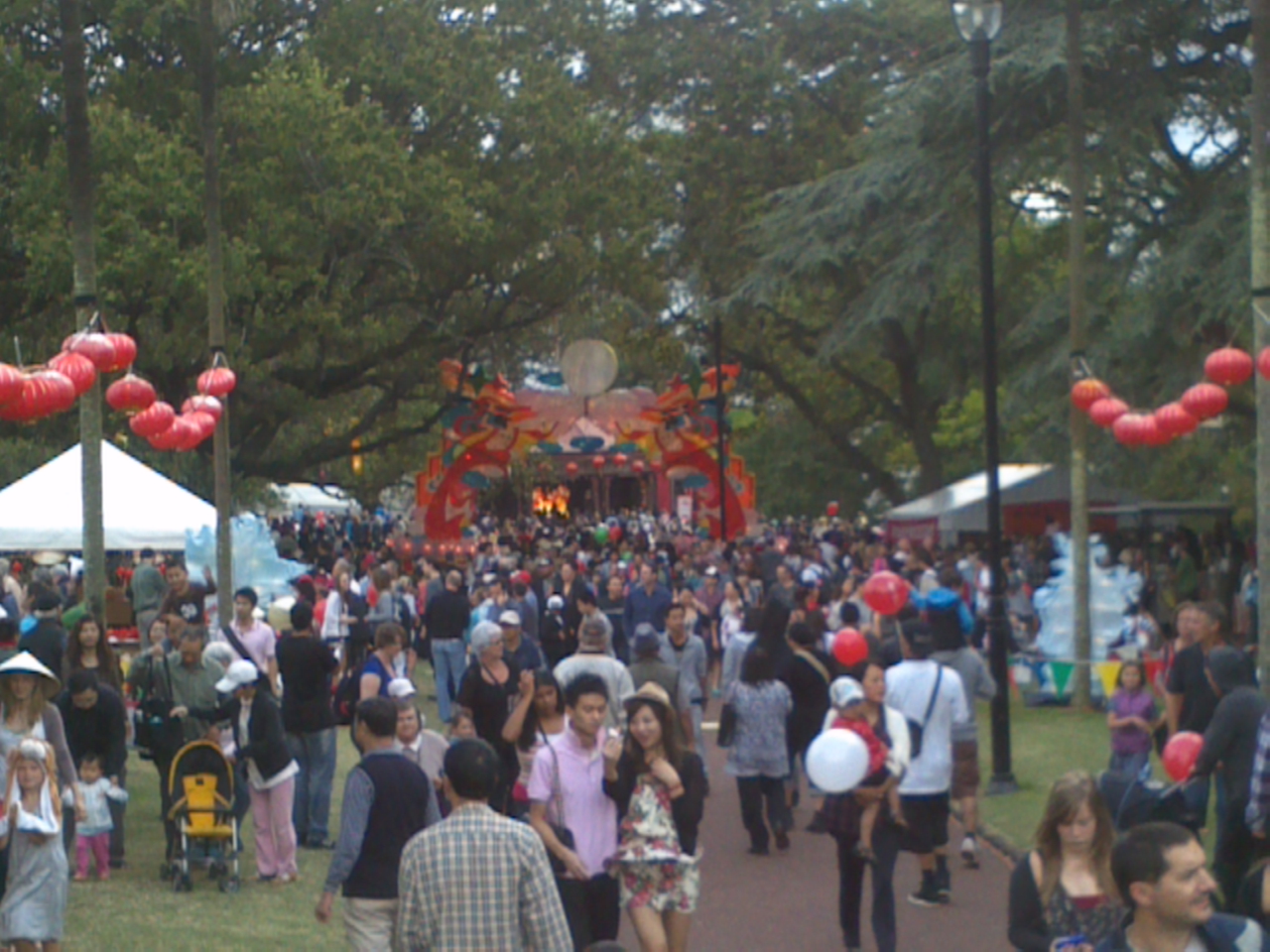
But then we have events like the Lantern Festival (and Diwali) to give us that connection don’t we? That annual gathering, mixing and mingling of mostly local Chinese and mostly mainstream (white/Pakeha) where everyone sees each other, feels good, eats Chinese food, sings karaoke, watches the fireworks, checks out the imported lanterns and goes home. Until next year. If the aim of such an event is to bring in a zillion footfalls and therein be successful then that is fine. Any B grade movie aimed at the lowest common denominator does just that. It is called mindless entertainment.

Imagine this:  Within the interiors of a HR department:

Two Pakeha read the top page of resumes and throw them in a rubbish bin.

PERSON A :Wong, Leung, Kwok, Kwon, Yik … no, no, no.

PERSON B : Oh you’ve got Asians in your pile too?

PERSON A : Yeah, seriously…no speak Engrrish … I don’t even bother to read through. PERSON B : I know! I just wish someone worthy applied, makes things easy you know … so what did you do over the weekend?

PERSON A: We went to the Lantern Festival. It was so good. I ate so many dumplings and the lanterns they were amazing.

PERSON B : Weren’t they just? I look forward to the Lantern Festival every year. It is so much fun.

PERSON A : My family just love Chinese food. We go to yum char once a month for sure. PERSON B : I love yum char! Which is your favourite yum char place?                                                                                                                     FADE OUT.*

Does multiculturalism, as implemented by governments and related organisations, break barriers via events like the Lantern Festival (and Diwali) or perpetuate the other-isation, exotic-isation and ghetto-isation of ethnic minorities? I would argue that in the larger, multicultural context of this nation, an event like the Lantern Festival is aimless. Like giving popcorn and fizzy drinks to malnourished children so as to feed them but it is not the correct food is it?. Do we learn about Chinese people and Chinese culture at the end of it all? Do we know about their (and by extension other ethnic minorities) contribution to Aotearoa New Zealand?

How many of these visitors are going come away with more knowledge of the local Chinese?

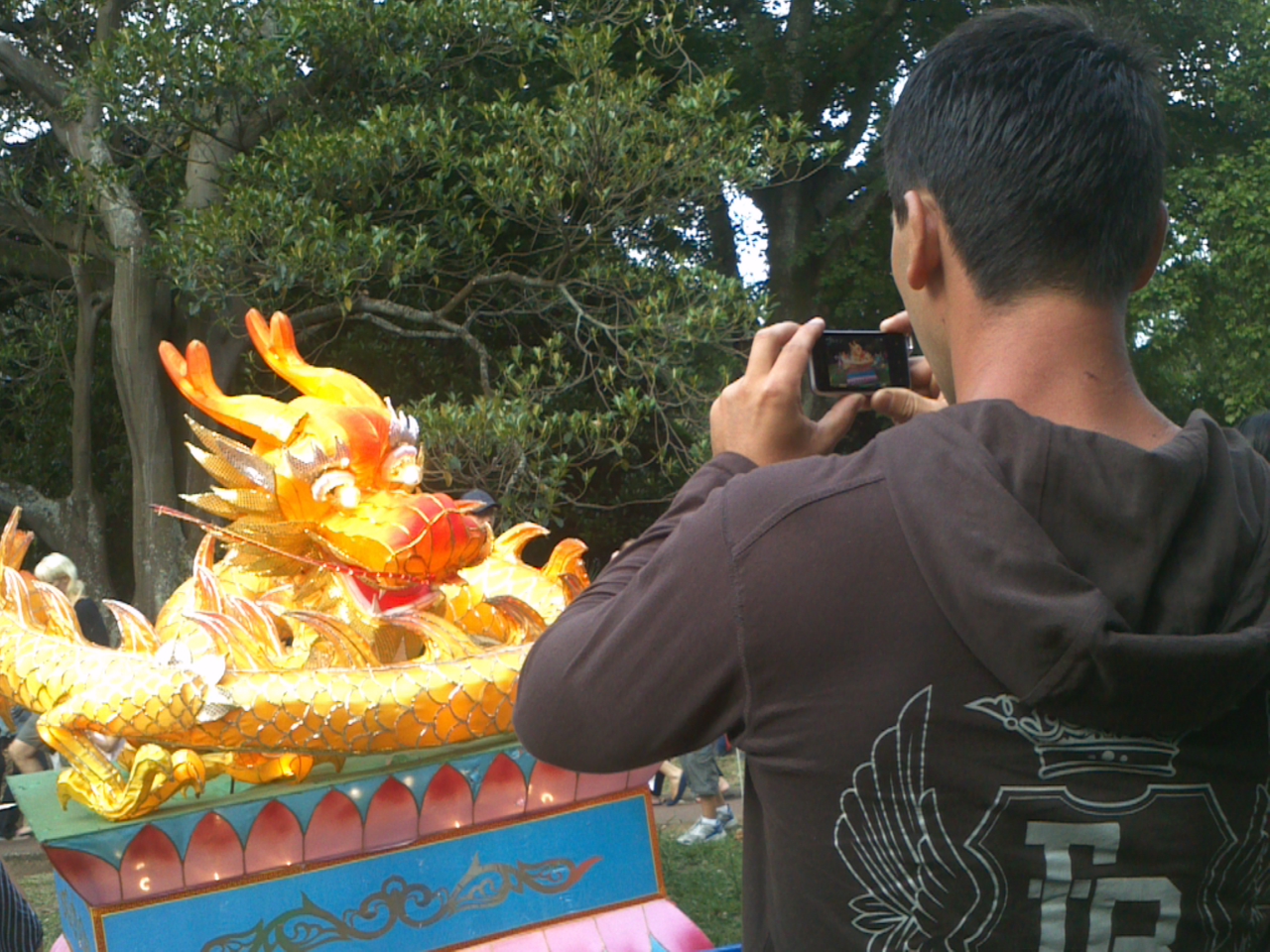
Just another photo op.

Andrew Butcher of the Asia:NZ Foundation says that ”The immediate stuff in our neighbourhood I think that requires a wee bit more work and a wee bit more adjustment.” (In this article on overseas investment figures.) How much is ‘a wee bit more’? Theoretically, if the festivals organised by the Asia:NZ Foundation were meant to change perceptions about Asians, then, in the last ten years since these events began, New Zealanders would want to know about the dumpling-maker rather than just eat the dumplings ya? Unless of course the idea is to exhibit ethnic minorities as anthropological specimens on an annual basis and feel good about how diverse we are.

So, a wee bit more is actually work on a daily basis with everyday cultural existence and behaviour that is normalised and integrated. Not merely teaching Asia in schools or commissioning research that the media reports and forgets. A wee bit more is about the chaos at grassroots level that grows into a movement for sustained, constant visibility and finally acceptance. A wee bit more is empowering minorities and expanding their thinking not just engaging with community leaders and community elites.

Should white people be in charge of showcasing the ethnic minorities of New Zealand? Or teaching Asians about guanxi and how to be Asian or telling young Asians to go on their OE to Asia?  Asia:NZ is white people. (Pardon the English.) Perhaps it is about maintaining colonial, hierarchical power structures to keep ethnics in their place. Is there a wee bit where the ethnics get a say in their representation (minus the dumplings and Bollywood dancing)?

Let us suppose that these festivals are ‘soft power’ projected by New Zealand and packaged with economic incentives for China/India/Asian countries. To attract and persuade them that we are a multicultural nation and we take care of our ethnic minorities. (Look! We celebrate their festivals!) That’s great. We need more trade so why not. Then (a) why fake the concern for the communities and their culture? and (b) if the love for the local ethnics is genuine, is any of that money coming in be going to used to towards creating a robust, egalitarian society that is less racist and not so xenophobic?

Also, for the sake of argument, one can say these festivals are better than nothing. At least we ethnics get a chance to gather and show our culture. Sure. Does that mean (a) we shouldn’t try to improve upon the concept and (b) not question how, our representation, as shaped by white people, remains shallow and superficial? Or how their idea of multiculturalism is about reducing inherent complexities and preserve white supremacy? Where real, existential issues of ethnic minorities are overlooked in the name of cultural maintenance, where the elites from ethnic communities are deemed cultural representatives, where cultural certainty and ‘authenticity’ is the only thing allowed so white people can decide who you are? Multiculturalism which insists on staying static despite changing demographics.

That of course brings up the question of so called community leaders and patriarchs. Who, in most cases, are more interested in photo-ops with the Prime Minister and getting on panels and boards or becoming famous. Maybe these people agreed to the idea of ethnic festivals, to Diwali and the Lantern Festival ten years ago. How about seeking a review? In my experience they would rather be subservient to the government/Asia:NZ as long as their status in the community is maintained.

One way to move is to dismantle the hierarchical structures that insist on representing minorities. Then to rebuild. To separate international trade and business from local celebrations of culture and are yet connected because economic development is common to both. To restructure such as to engage with grassroots, where diversity is not a commodity within the soft power of our nation but a real value, where Asians are in charge of Asian culture, where young Kiwis of Asian origin have a say because this is their future. Asia:NZ is due for a new CEO. Maybe an Asian CEO? Perhaps a complete rehaul?

And for all this ethnic communities have to reflect upon their own place and culture; to break the model minority myth, to build relations with each other even as we work through cultural maintenance and identity, so we have a say in the matters of this nation, to be seen as more than pawns by political parties and the white echelons. Remember what Uncle Bob said? Otherwise,

Most people think, great man will come from Wellington, Make a flash festival and make everybody feel high.…get up stand up…

*sorry for the wrong script format and apologies to my Chinese friends for using their surnames.