http://kiwistargazer.blogspot.com/
I may not have enough time to write one of my ponderous blogs but here is one that I enjoy from time to time. Anjum Rehman has a definite point-of-view and is a wonderful person. More power to you sista!
http://kiwistargazer.blogspot.com/
I may not have enough time to write one of my ponderous blogs but here is one that I enjoy from time to time. Anjum Rehman has a definite point-of-view and is a wonderful person. More power to you sista!
It is that time of the year when the local councils in New Zealand and Asia:NZ have ‘official’ celebrations of Diwali in Auckland and Wellington. White folksy interpretation of a Hindu festival with Fiji-Indian conceptualisation and a sprinkle of Hindu fundamentalism disguised as Bollywood. It is a great way to carry on the Free Trade Deal (FTA) dialogue with India, apparently. But definitely a sneaky way for the fundamentalists to hoodwink PC, dumb white folk to think that Hindu=India, all at once homogenous, exotic, hard to understand and where everyone eats samosas. Whoever said cultural integration of diasporic peoples cannot be simplified so as to tick all the boxes? Then we all live happily ever after.
It took me three years to complete this documentary. I went into the homes of my people here, engaged with bright, enthusiastic school kids who have no platform for expression and listened to the ‘elders’ lecture me on the meaning of ‘being Indian’ (or how important they really are). I also got an amazing story from a old, old man, now deceased, about how he went back to India and participated in the struggle for freedom. There were many of his generation, who, inspired by Mohandas Gandhi, travelled by sea to India to resist British rule. That unfortunately is not part of the video inserted below but I hope to tell the story some day.
Filmmaking is hard work and without money the only things that sustain you are passion and a burning desire to tell a story. If I had any funding for this film it might have been a different product. However, the journey so far has made me determined to continue telling stories that don’t fit trends or showcase the exotic peoples of the East and Africa, even as case studies in neo-liberalism. Middle class Indians across the world are a force to reckon with economically but most of the time (I assume, from my experiences in New Zealand), really not interested in political movements or resistance or protest unless things affect them. Equality and solidarity within humanity is not worth the same as Indians being equal to white people. So we continue to perpetuate stereotypes of a model minority imitating culture from back home and compare ourselves to imperial masters, even aspire to be them. There is a little sliver, a gap somewhere in there though where the stories stay invisible, unheard, un-articulated. Emotions that overlap, experiences that are shared with all humanity. That’s where I attempt to work. This film is the first of many more to come, as many as I can possibly make in this life. Enjoy!
In part one of this blog I introduced my argument and quoted Milton Fisk. Multiculturalism in New Zealand is based on a neoliberal model that recognises diversity but does not allow it flow over into the mainstream because that upsets the economic structure and global expression of the same. I used as a starting point an article by Henry Johnson and Guil Figgins that: (a)Examines the re-contextualization and transformation of Diwali in New Zealand with emphasis on performance (b) Explores the role that various organisations have and looks at (c) The ways in which performances are expressions of self-identity and part of a process of place-making.
Re-contextualization/Tranformation:
The paper says Diwali Downunder is a secular affair that is recontextualised and transformed into a celebration.
Diwali, as celebrated in India, is a family affair. However it is still public in a way because the entire country celebrates it according to region and community. So it is a public-private affair. There is no place for communal performance of any kind especially Bollywood. The ‘transformation’ cannot be called secular because the very nature of the festival excludes non-Hindu South Asians-it is a Hindu festival within a ‘homogenous’ space as per organisers. Perhaps because India is a larger economy than other South Asian countries? In my film Jennifer King says that since the Chinese Lantern Festival was successful, they decided on Diwali. (So a non-religious Chinese festival is the same as a deeply religious Hindu festival?) Then the very nature of this does not offer any scope for re-contextualization. My questions:
Organisations and events:
The paper says that the role of the organisations is positive and Asia:NZ’s role (then known as Asia 2000) contributes towards developing visibility.
To a certain extent that is true but what has the role of Asia:NZ to develop visibility of the Indian community got to do with social integration? Asia:NZ Foundation was established in 1994 by the Jenny Shipley government (National) to help develop better economic ties with Asian countries. On 7/11/2004, the tenth anniversary of Asia:NZ, Phil Goff (Labour), then in government, said in a speech in Parliament “Ten years ago, New Zealand had embarked on a policy of active engagement with Asian economies. We had expanded our ties with Asian countries on a number of fronts – politically, economically and diplomatically. …”
When you have economic benefit as your core ojective then culture has to be shaped and presented accordingly. Diversity becomes a commodity instead of a value.
Then organisations develop mutually beneficial MOUs such as with Auckland City Council.
Self-identity and Place-making:
Expression of self identity means taking charge of who you are. Culturally, ethnically and in the present. It means challenging notions of being the ‘other’ to oneself and to the mainstream. That goes beyond recognition. It is about equality.
Placemaking comes from telling stories by owning a place and you own a place by actively participating in the place/space. There is only passive participation in the Diwali Mela.
Indian culture then does not spill into, flow into and mix with other cultures or even the mainstream. How then can social issues be addressed?
What multiculturalism then?
It is clear from the current neoliberal model of multiculturalism in New Zealand that migrants and their diversity are recognised for economic benefits. The inference in my film is the same. “Food, footfalls and festivals for cultural consumption…my identity reduced to song and dance to satisfy the stakeholders…” Here the stakeholders are the organisers and sponsors. The Indian community is clearly not perceived as a stakeholder in an active, participatory, decision-making manner except to please them about their presence and numbers at an annual Diwali Mela. As if seeing others like yourself once a year in masses is reassuring of your place and space in New Zealand.
I do not have a clear cut answer to which model of multiculturalism New Zealand should seek. It is a matter of korero, dialogue.
Milton Fisk: ‘The cultural view of recognition stays within the bounds of neoliberalism. … the social view of recognition does not counterpose recognition and equality; instead, it makes equality a vital part of recognition.’
Amartya Sen: 1-Promote diversity as a value in itself. 2-Focus on the freedom of reasoning and decision-making positively supported through social opportunities.(Identity And Violence The Illusion Of Destiny. Sen, Amartya. Allen Lane-Penguin Books, 2006.)
Tariq Modood:1-Socio-economic opportunities and outcomes. 2-Socio-cultural mixing. 3–Civic participation and belonging (Open Democracy blog)
New Zealand is unique because we have the Treaty Of Waitangi that no other country in this world has. Any form of multiculturalism cannot be propagated without involving tangata whenua. How does the Diwali Mela create a dialogue with Maori? What is the place of migrants as tau iwi? If migrant culture is seen as economically viable to sell the idea of New Zealand as blissfully diverse, to tell India and China that their people are loved here so let’s get on with the FTA, then Maori will become invisible to migrants. That would be perilous.
And after all this, I must make clear that I am not against the Bollywood dance competition or Diwali. It is the implementation and institutionalisation that is problematic. Besides, the Indian community in New Zealand, the youth need to take charge of their identity. Not just as ‘Indians’ but as New Zealanders. They need to question their space here. Merely doing an anti-Paul Henry dance at Diwali does not stop the racism. Neither is it resistance.
This blog I have put together from a presentation I did at a Symposium in Dunedin ‘Interrogating Multiculturalism in New Zealand: An Asian Studies Perspective’ jointly organised by Otago University and Victoria University. It is still rough and there are some gaps to fully support my argument but I prefer to post it rather than write a longer academic article (and it is still in two parts). A friend advised me to read Foucault and Derrida but I do not have the time to digest such heavy reading. You can either agree or disagree.
The title comes from my documentary film DANCE BABY DANCE naach gaana hum aur tum that I made to examine the representation of the Indian community in New Zealand via the Bollywood dance competition at the Diwali Mela organised by Auckland City Council and Asia:NZ Foundation. The questions I asked myself and put to the viewer were ‘What does it mean to be Indian in New Zealand?’ ‘Who are the people that decide?’
When I first came to New Zealand and discovered that Diwali is celebrated as a publicly funded* festival through the organisations above, I was happy and excited. It was a way of sharing my culture with mainstream New Zealand. But the more I saw this festival the more uncomfortable it made me. Is this how multiculturalism is officially expressed in New Zealand? An annual festival that brings in footfalls and local Indians but to what end? How does this help in integration? How does it create a platform for querying your space and identity in New Zealand? What is the discourse around it? Is there a critical discourse? If not why not? The only way I could find out was by making a film. I interviewed the organisers and followed five different kinds of participants as they rehearsed for the Bollywood dance competition (since this was the ‘showstopper’ and heavily promoted and also the most problematic) . What did I infer at the end?
I needed academic backup to support my conclusion. My arguments come from the point of view of being an ‘ethnic’ media practitioner in the mainstream media of New Zealand who is on the fringe of the community and the mainstream by virtue of being neither or both and hence requiring me to be think in a critical manner. Outside/inside or inside/outside.
To begin, I referred to an article by Henry Johnson and Guil Figgins: Diwali Downunder-Transforming And Performing Tradition In Aotearoa New Zealand. This paper
a) Examines the re-contextualization and transformation of Diwali in New Zealand with emphasis on performance
b) Explores the role that various organisations have
c) The ways in which performances are expressions of self-identity and part of a process of place-making.
I’d like to argue that all three are limited and shaped by neo-liberal ideas of multiculturalism that converts migrant/ethnic cultures into soft, non-threatening consumable exotica to maintain the position of the ‘other’ rather than allow for integration. This then (a) Creates a space for passive participation (b) Continues to ghettoise the community (c) Sweeps social issues to the fringe or under the carpet because those are not part of this form of multiculturalism. Cultural differences are celebrated and accepted but rigidly maintained and not allowed to ‘spill over into an effort to have equality of a form that would run counter to the economic norms the regime is expected in the global context to protect.’ I quote Milton Fisk, Professor Emeritus of Philosophy, Indiana University who wrote about Multiculturalism and Neoliberalism. “…in the liberalism and the neoliberalism that associate closely with a positive view of the economic market, the notions of equal worth and equal dignity do not imply a right to economic equality but only a right to recognition. Here recognition implies…no more than an acceptance of others with their difference and of the task of maintaining that difference when they desire that their difference be maintained.”
Recognition of diversity is not the same as equality. It is a diversion from normalising and engaging with migrants and their lives and stories in New Zealand. Negotiating multiple identities and existence in New Zealand-they get lost in this ‘recognition and endorsement’ of popular Indian culture (Bollywood) and its economic hegemony. This recognition is like the carrot, it leads to the mirage of freedom and equity. But for the Indian community in New Zealand this multiculturalism continues to underscore and locate representation in food, clothes and performances rather than an exploration of their inherent complexities and space in New Zealand or creating a platform for democratic participation and open, critical discourse. Eventually failing to translate into wider cultural engagement or integration because it is always the ‘other’.
——————————————————————end of part 1——————
*The Diwali Mela is funded through various private sponsors, the Lion Foundation and advertisers but the primary organisations are government bodies who ‘raise’ the money, hence I use the term publicly funded.
Salman Khan says nationalism is his religion. Not Bollywood PR speak, no. I watched, gobsmacked, the man himself on television say the thing just like one would say, “Keep Your City Clean” or “Hum Do Hamare Do” or “Do Not Spit”. Nationalism is a public-spirit-morality-love-your-country message. Jingoistic patritotic populist.
What is nationalism, I tried to ask. Tried because no one wants to have conversations pertaining to such topics.
Nationalism means loving your country (you silly thing)! Nationalism means feeling pride for INDIA. Nationalism means being the best superpower, kicking gora, chini and every other (especially Pakistani) arse. Nationalism=patriotism and all that. You know, like, proud to be Indian?
The Stanford Encyclopaedia Of Philosophy describes both patriotism and nationalism at length. Briefly, nationalism is (1)the attitude that the members of a nation have when they care about their national identity, and (2) the actions that the members of a nation take when seeking to achieve (or sustain) self-determination. Patriotism can be defined as love of one’s country, identification with it, and special concern for its well-being and that of compatriots. The two often overlap, especially in political discourse, when such concepts have to be simplified for a supposedly not-so-smart hoi polloi and ultimately turning the psyche into ‘us versus them’.
So when Salman exhorts everyone to become nationalistic, he also means patriotic. LOVE YOUR COUNTRY! DIE FOR YOUR COUNTRY! WE ARE THE BEST! IT IS OUR TURN! This then becomes all about world power, domination, aggression and ultimately bad behaviour. I noticed. Along with being a fast growing economy, along with becoming flatter and flatter (as per Thomas Friedman), we also become obnoxious. Because all the other superpowers are like that. Look at America! (Say that with an upper middle class Indian accent.) The popular discourse of ‘us versus them’ then steering towards our own people. Urban versus rural, Hindus versus Muslims, rich versus poor, caste versus caste. Anything or anybody that looks like an obstacle in ‘development’ and ‘progress’ ultimately unpatriotic. The non-violent gentle soul that I am, I was shocked at the hatred Indians had for ‘others’.
In his book, The Idea Of India, Sunil Khilnani asks the question Who Is An Indian? Such a vast, complex country, a palimpsest (Jawaharlal Nehru in A Discovery Of India) is obviously difficult to govern. To then push the idea that mere economic development will cure all ills and ailments, that consumption will make us happy and malls the next destination for pilgrimage is bound to create the demon of nationo-chauvanistic-alism. The Indian media plays a big part. Bollywood booty shakes juxtaposed with rape cases and corrupt politicians along with the rise in food prices. Where is the time for reflection and introspection in between advertisements? And certainly not for temperate language. It is all about fear, insecurity, drama and money. I don’t know if any Indian television station has correspondents stationed in other countries. How can there be any conception of what this existence is?
I personally do not believe in patriotism. Nationalism is a useful notion only until a goal is achieved. After sixty years of independence, India and Indians do not need to either. Democracy and freedom come with responsibility and that has to be constantly discussed in the public domain. To be a world power we have to look within. To lead we do not have to be aggressive or harsh or try to control others. We also have to engage with the rest of the world. We certainly don’t want to be America or emulate her foreign policy or suck up to her. (But even in the West, the dialogue about democracy and problems continues.)
Whenever I tried to talk such I was told that since I’d left India for the West I was a traitor or sorts. So what gave me the right to opine? Because India is an inherent, non-negotiable part of my identity. Because I believe India can be a country to be reckoned with and not just in economic terms. Because India has the potential but only if Indians do serious introspection.
Jingoism is ugly and immoral.
Dharamshala existed in my dreams. For the longest time. Ever since I first encountered Tibetans. Way back in Bombay, during a non-existent winter (as Bombay winters are), laying out their winter wares on the pavements near Kala Ghoda. Imagine selling warm clothes to a Bombayite! Curious, I got talking to them and they told me about their journey from Dharamshala to my city. Sing-song Hindi, smiley, crinkly eyes. Then another said she had come from South India. Whatever little knowledge I had of Tibetan refugees, that bit, about a settlement in Karnataka, was news to me. After all, for the average Indian, in the days of Doordarshan, newspapers and the neonatal period of cable television, Tibetan refugees=Dalai Lama=hospitable, warm, fuzzy India + neighbourly concern. I was hooked; an invisible bond attaching me to these people from the Himalayas I know not why. But journeys happen and how.
One day, out of the blue, or so it seemed to meine familie, I declared I wanted to work at the Tibetan hospital in Dharamshala. They thought I was mad. How could I leave Bombay and my home and medical practice to go to a ‘hill station’ ?! I’d written them a letter see. In the pre-webbed India, where getting any information was like looking for a needle in a haystack, I had blindly written, on the blue inland letter of Indian Post, to ‘The Tibetan Hospital, Dharamshala, Himachal Pradesh’ asking if I could work at the hospital. I got a reply. Yes you may but only as a volunteer. They kindly included instructions on how to get there from Bombay and also a telephone number. Could I get past the wrath of the family though?
Then I visited Sikkim. It was a trip offered to me by an uncle. He said Singapore I said Sikkim. So I was on a flight to Siliguri via Calcutta and then a bus to Gangtok, promising to call my mother everyday. Me and the backpack, one more nail in my ‘she-is-mad’ coffin. I can still feel it. Walking the streets of Gangtok, visiting Enchey Monastery, a yak ride on Chhangu Lake, going up to Nathu La looking over Tibet, the twisting Teesta river, Pelling, the shrouded Kanchenjunga…I bought my first mekhla, the traditional dress from North-East India, in a tiny village near Pelling. That was my second calling. When the Himalayas beckon you cannot ignore.
This year I was meant to go to Leh. The tickets and accomodation booked. Then the cloudburst happened.
One can say that the Tibetan refugees are doing well in Dharamshala (McLeodganj technically because that is where most of them live and that is where I stayed.) They are allowed to practice their religion, arts, culture, do business and go about their lives. Peace prevails. Co-existence and tolerance exemplary of Indian hospitality.
The poverty is shocking. New Zealand has an annual intake of refugees from across the globe with a settlement process and follow up which is still not enough to ensure integration, where identity is always in crisis, mental health always an issue and the many manifestations of suffering unknown. What could be the state of a people living in limbo for the last fifty years? These people who followed their spiritual leader with the firm belief that they will return home one day but exist on an annual special permit? Now a second generation is born in exile and the refugees keep coming, running away from torture and annihilation. Of course the tourists come too and they bring the money. So what? How many street stalls can you have selling the same prayer wheels and beads?
The chaos that is India is evident in McLeodganj. So is the ‘progress’-pieces of hill being cut to build malls and fancy hotels with saunas. Then there are the monasteries hidden in the by-lanes, full of monks who cannot speak a word of Hindi/English and who subsist by teaching Tibetan/Buddhism to white women in tight tee shirts and no bras. (Of course you get that in Varanasi too-with the marijuana-so spiritual tourism is not just about the Tibetans.) It is the lack of status that broke my heart. Old people with diapers and no teeth, ordinary people who want to go home, women beaten up by unemployed husbands, single mothers…newly born infants, just gorgeous and cuddly, who will probably never know home. Except in museums, fossilised. All living where they don’t really belong or want to belong.
Yatha bhuta, anicca. Perhaps. But does that justify suffering? Would it be unfair to ask why India has not done more towards mediating talks between China and the Tibetans? Because offering space and place is enough? Because there are no ‘Indian’ refugees and hence we do not understand the psyche of displacement? (Post-partition Hindus, Muslims, Sikhs, the Kashmiris, tribals pushed out of their land, debt-ridden villagers migrating to cities…refugees.) Because it is geopolitically not prudent to engage with China on this? How about being a world leader in developing and maintaining human values? (But then we would have to have our own house in order no?)
I would like to believe that the Tibetans get their strength from Buddhism. The non-violence, the peace, continued grit and determination. To treat them like ‘temporary refugees’ and not being pro-active in helping them realise their homeland not only undermines them but also reflects on our own core values and spirituality. Superpowers are not merely economic.
My tomatoes are ripening. Check this out the photo.
And the calendula too. Although the coriander has failed to grow and my experiment with pomegranate too.
I wonder now if I need to buy coriander seeds from the plat shop…perhaps mine are genetically modified terminal seeds? The argument for and against GE/GM interests me no end. Of course I am no expert on it but the thought of genetic engineering makes me shudder. This is not paranoia. As a qualified medical professional I know the importance of science in saving lives and decreasing human mortality as well as morbidity. A lot of the world’s population would be long gone without chicken pox, polio, tetanus, pertussis (whooping cough) and all the other vaccines we take as part of our immunisation schedule. Small pox was eradicated because of a rigourous schedule implemented by so many countries. Cervical cancers are probably going to reduce in prevalence because of vaccines (and smears that will catch the cancer in situ). So I am not against scientific advances in food or food technology. There has to be a way to reduce world hunger and food prices are going to go up no matter what because there is only so much land to till. That is why I guess for me it is an important part of my life and existence to grow my own food. Some of it anyway. The beauty of Auckland (and New Zealand or even Australia) is that no one looks at you like you are a nutter if you say you are into gardening. My friends in India don’t get that. We never grew up with a culture of growing your own food. Not in Bombay anyway. Old Bombay, Girguam, congested, chaotic, crowded and low on water. We used to and still get our water supply from the great Brihanmumbai Mahanagar Palika (or the good old Bombay Municipal Corporation-before the parochialists screwed it up) at 5am in the morning. I filled up buckets and tanks and pots for years. My mother still does it. So there was no culture of growing any plants except maybe for decorative purposes. I think that should change. I think with modern technologies we can grow some of our food in our apartments and share it with our neighbours. We can create our own compost-if we follow the rules and respect each other-and use the product to fertilise the land. Give back to Mother Earth. I now dump some of my kitchen scraps in the worm farm that my neighbour offered to share. It is full of gorgeous little creepie-crawlies and other microscopic organisms that do what they are supposed to do. Keep this ecosystem going. 


I guess it is hard to spot all the little living things in the last photo but they are all amazing! What we as humans have to do is understand the ecosystem and that we need it for our survival. Long after we are gone due to some nuclear holocaust, when cockroaches are the only survivors, they will continue to evolve. My greenie, hippy heart looks for the day when it will dawn on more people than those of us fringe dwellers that ‘green’ does not mean some decorative useless plant and food does not have to come from supermarkets. In Auckland, up at Bastion Point, in the Orakei Marae, replete with so much history, the local iwi Ngati Whatua are growing food and bringing back native flora. In a project called Ko Te Pukaki the entire land is being re-forested and there are vegetable gardens, kumara pits and all kinds of flax being grown. Even Auckland City Mission send their homeless clients (is that the right word?) to tend the gardens and a lot of the food goes back to the Mission kitchens. The oh-so-dynamic Ngarimu Blair is the driving force behind this project. (Watch out for him..he might be PM one day.)
Yeah so one day I hope more people start being pro-active about growing their own food, understanding where our food comes from and how we consume it. The other good thing about Auckland for me is the fruit that grows on streets or in communal backyards. The feijoa in my backyard is already giving fruit 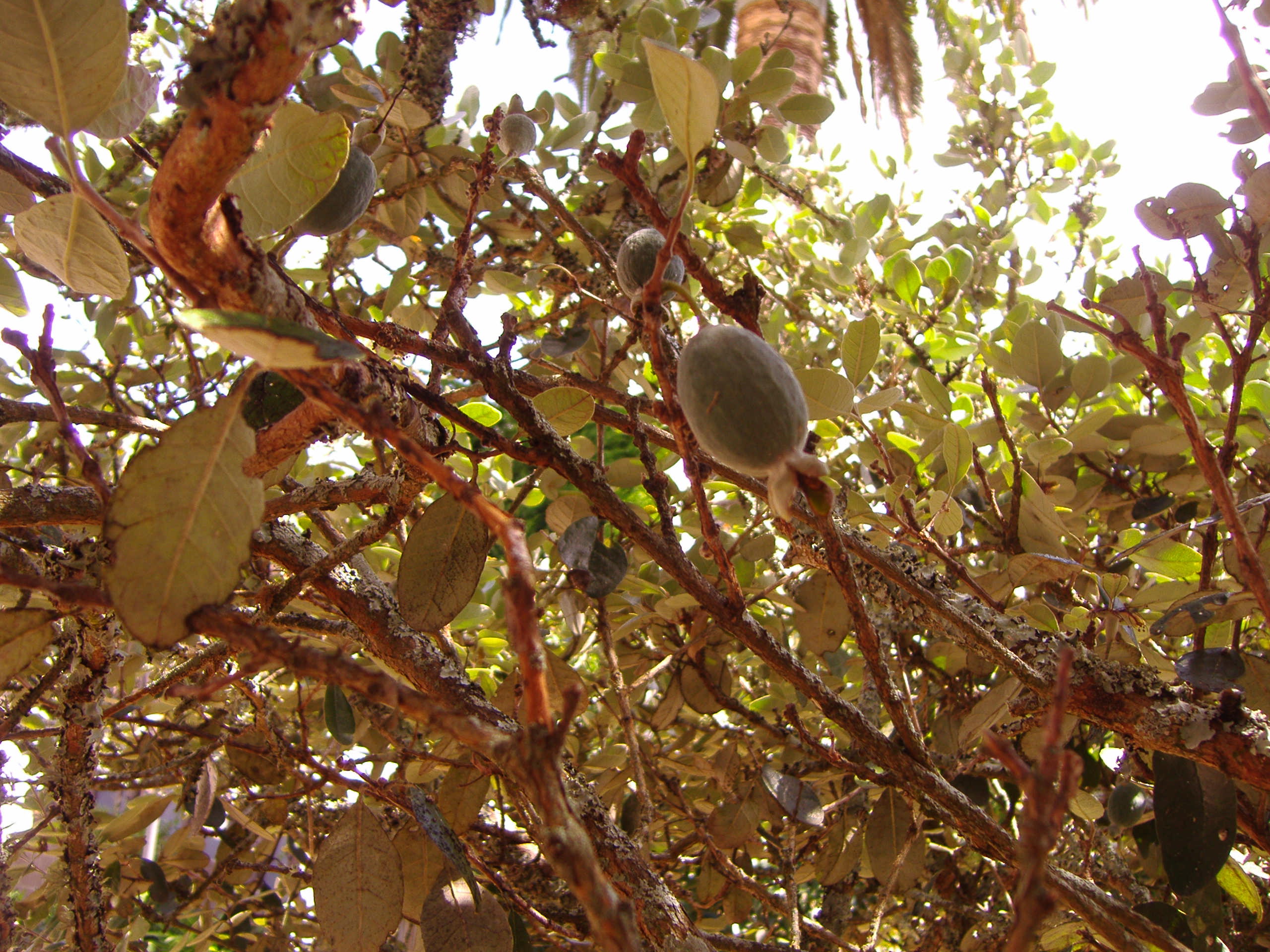
and I wait for the red guava tree on my old street to start fruiting (right word?). I did not know red guava existed until I saw this tree. They taste really good, slightly more acidic than the green guava I used to have in India. Apparently you can make jam from guava. So maybe if I gather enough next month I’ll try that (and write another blog).
Before that one last picture. The brinjal I planted i just beginning to flower. Another month before I get anything edible.

Another long overdue post! Life is so busy I do not have time for self-indulgence! How terrible is that? No time to pump up my ego and think of myself as a world-changing writer 😦
These last few days I have been in and around the criminal neighbourhood of South Auckland carefully making my way inconspicuously through the dregs of socio-economic losers in case someone wants to mug me or snatch my bag. Shame some of the houses are lovely and the parks quite nice, the artworks and creativity busting to be acknowledged. Nah! Just kidding. Melissa Lee, the National Party candidate for Mt Albert by-election, said it all two weeks ago and much has been made of the motorway-keeping-crims from South Auckland-away. So I shan’t diss her no more.Only point out (or say I said so) that just because one is an ‘ethnic’ or coloured or a minority does not mean that one believes in equality and justice for all. That is a state of the mind. An ideology. Right-wingers can come from anywhere even the poor.
Election campaigns are always entertaining and all candidates talk bullshit at some point. I immensely enjoy elections and campaigns. And nothing more entertaining than Indian elections.
At one level I feel stupidly patriotic and proud that in spite of naysayers and doomsday prophets India has continued to confound the world by the relatively smooth electoral process that takes place every four-five years. It is a massive, complex operation in a huge and diverse country. It has to be transparent too. Indians do it over and over again. As if there is an inherent need to believe in democracy even though it may not work the way we want it to. Am I making sense? When surrounded by chaos, terrorists, military juntas and communists-the way India is-the only thing to believe is in oneself, the right to choose and be free. This time the election results were so decisive that the right-wing Hindutva will have to think hard about killing any more people and building temples. Not that the Indian National Congress is innocent or blameless. There is a lot of work to be done and we really should get over to being an American minion. In order to be a real global player we have to have our house in order, look at health, education, environment, the arts, representation of minorities and women. Like all Indians I have an opinion on how things should be done but my theory is not yet well-formed and I don’t have an answer/solution to all the problems. The only thing I can say is that we have to build the country on peace, love and inclusion.
Which gets to me to the point of parochialism. A professor of English who recently read my blog asked me how I could be supportive of Raj Thakeray (see Frogs In A Pond-I) when I advocate multiculturalism in Aotearoa New Zealand. Naturally I was appalled. Gosh! I thought my politics were pretty clear. While I acknowledge that there are issues in Bombay/Mumbai and particularly in the Marathi areas, the solutions offered by Raj and Co are not. What Raj and the Maharashtra Navnirman Sena are doing is to work up the fear factor and to make people insecure instead of inclusive and broadminded. Mee Marathi but that is not my only identity and I recommend it should not be of other Maharashtrians either. That MNS candidates ate into the BJP-Shiv Sena votes in Maharashtra, particularly Mumbai goes to show the unfortunate support it has amongst Marathi people. How that is going to play itself in the upcoming state (Vidhan Sabha elections) is anybody’s guess.
It comes back to bite you in the bum.
I have just finished reading Thomas Friedman’s ‘The World Is Flat’. It was an informative read. I now know what captains of the globalised world think. It’s all great stuff, the corporate language. I learnt a lot. The book is full of big names in business and government-all those that decide how the world works. They think the world is flat. I agree somewhat. This flattened world has been good to me. Considering I am a digital migrant. I got my first computer in 2001 now I get frustrated that I cannot update on Twitter from my mobile phone because it is not free in New Zealand. I can connect with old friends and make new friends, network and even date online because the world is flat. I can write this blog from my eee pc, sitting on my bed, because of my home hub and because the world is flat. How cool is that?
Two days ago I came across this is in the book ‘The Power Of Seduction’ ( by Jean-Claude Hagege). He talks about cosmetic surgery and advertising. ‘The insane acuumulation of images, no matter how beautiful, are lures to catch the buyer…and the sum total of these images behaves like a subculture with its own references, its winking, its provocations and even its scandals.’ The gist of Friedman’s book is akin to that. Creating a flat, capitalist world that justifies its existence on the basis of increasing consumption without a thought to side effects or after effects. Maybe only I can see this connection? Or is it my politics? I mean I am probably not as smart as all the big names in the book who talk about globalisation, war, politics, business etc without talking about people and human behaviour. Displacement, disenfranchisement, destruction…they all lead to disruption and that, according to this book, is not the problem of the big businesses. It is the problem of the people themselves if they want to be left behind. It is the problem of Al-Qaeda and Taliban, it is the problem of despotic governments. They need to sort it. Not a word about American imperialism (yeah yeah some superficial reference to foreign policy etc) or even the hegemony of multinationals. I drink tap water and buy stuff at op-shops or on Trade Me, I guess I don’t know.
Perhaps this is beyond the scope of the book, perhaps I am seriously ignorant because I have never read any of Friedman’s work so don’t have any context. I’ve never run a business until now, I don’t belong to a business family and I am a single, brown female who thought computers were for engineers while I was growing up. Funny that the book has no reference to what my culture could possibly be as an end user in the post globalised world. Honestly I get upset when I come to know any of my relatives are working in call centres or outsourced back offices in India. Where is the personal growth there? Aren’t these kids, with their big salaries and faux American accents being turned into consumers? What is there to get so gung-ho about outsourcing? Just because lots of businesspeople are making money?
I am not against globalisation or outsourcing or insourcing or any of those other business terms used in the book. It is the condescending tone of the book that is troubling. It is problematic from page 1. So I started making notes as questions. I cannot give references about the exact page numbers or fully elaborate on the argument but my notes went something like this:
I found Friedman’s view of the world blinkered and uber capitalist. Yet he goes on to quote Karl Marx in a positive way! The arguments don’t even touch on how people have changed the world. It is insidious, just like fundamentalist ideology that obfuscates references to make converts.
No one can control greed. That is why there is such economic turbulence now. After creating consumers for decades and deliberately keeping the masses stupid and dumb, there is a revolution breeding here. Karma goes in circles, that is just the nature of this universe. The flat world will have to find a balance.
Let’s get straight to the point. When Barack Obama announced his transition team, to us Indians, the name Sonal Shah stood out like a beacon. We were finally getting there-or so perhaps. That is until three Indian-American groups protested the appointment. So what’s the big deal? We Indians know very well that we have a crab mentality and who goes up must be pulled down. So there were Indians in America who were probably jealous of Sonal. Oh we are like this only! Right? Wrong! The three groups, Indian Coalition Against Genocide (CAG), Indian American Coalition For Pluralism and Non Resident Indians For A Secular And Harmonious India were not pulling Sonal down. They were pointing towards Sonal’s links with the Vishwa Hindu Parishad, the right wing, Hindutva propagating, fundamentalist organisation. (Also established as The Hindu Council in various countries including New Zealand.) The CAG was instrumental in getting Narendra Modi’s visa to the U.S. revoked in 2005. Who is Narendra Modi? Just do a Google search. (Narendra Modi + Gujarat or Narendra Modi + Gujarat riots 2002).
Anyway, Vijay Prashad first wrote about Sonal’s links in an essay on 7 November and then followed it up with another on 13 November. Meanwhile the Indian media picked it up and then Indian communities and boards online went haywire. Those against Sonal’s association with VHP and those defending Sonal Shah.
I agree Vijay Prashad’s first essay was not a well-written piece. He was cautioning but not in a well thought out way. I know, I have been there. Last year when I spoke about the Hindu Council of New Zealand and the Hindu Swayamsevak Sangh (HSS, the ‘foreign’ version of the Rashtriya Swayam Sevak Sangh), there was much hissing and hate mail floating around. Everyone from ethnic poster-children of Aotearoa to hush-hush PC liberal types to religious ‘peaceniks’ thought it was improper for me to say it especially in the way I said it. All mostly with no or little knowledge of complex Indian politics and the methodology of the Hindutva brigade. Vijay Prashad was hauled over the coals. Not by the fundamentalists-no they are proud of Sonal and her association and they are not fond of him anyway.
Vijay Prashad was criticised by, whom I have figured out as, 1.5 or second geners who are proud to be brown and Indian but who have no idea of the methodology of the right wing parties in India. Oh they abhor the killing of the Muslims and the Christians and they think the Bajrang Dal is vile but that is just one aspect of their modus operandi. What about the slow, insidious indoctrination, the casual spread of hatred?
Please let me reiterate. I grew up in the middle of it all. And it is not easy to separate the ‘wheat from the chaff’…if you know what I mean. Here and now at my workstation in Auckland I can talk openly. Back home, in Girgaum, Mumbai, I would be shouted out – or cowered into silence!
If Sonal has done all that work to serve the poor millions of India and she has all those high qualifications then it neutralises her parents’ hardcore associations with the American branches of the Bharatiya Janata Party (BJP) and to Narendra Modi or even her own membership of VHP-A (She was the national co-ordinator and her membership has now expired apparently). How could Sonal have anything to do with the killing of ‘other’ Indians? Ridiculous! She has been hired for her work with Google, not her association with the VHP! (If I was a Nazi or associated with Al-Qaeda would I be hired for any job in spite of a grand resume?) I suppose raising funds in the US for relief work and all that in India is not yet being seen as translating into funds for Hindutva ideology. For people like me who have witnessed first-hand the insidious growth of Hindutva ideology amongst friends and neighbours it does translate into just that.
Anyway, to be fair to Sonal, she released a public statement to clarify her ties. It is classic. Put on the backfoot she says she has never been involved in Indian politics. One does not have to, living overseas. It is about influencing others to believe in the singular Hindu identity of India. It is about saying ‘Vasudhaiva Kutumbakam’ (the world is a family) but only Hindus please, thank you! She says she does not agree with divisive politics but has never come out denouncing the riots in Gujarat openly. Her do-good organisation Indicorps sends volunteers to work at Ekal Vidyalayas. Good idea to educate tribals, you know, and make sure they never leave the fold of Hinduism. (Yet still treat them like s*^t.) It fudges the issue. The classic methodology of the Hindutva people. Obfuscation. Just like Sonal’s statement. It is not hard. She may have grown up learning it – consciously or subliminally. What does the gora/pakeha know? Or the 1.5/second geners? Surely they are not aware that the stalwarts of Hindutva are avowed, unabashed devotees of Adolf Hitler? That their nationalism is not just about Hindus but about ethnic cleansing?
Now I am not a secular intellectual by any chance. I merely express worry. Maybe Sonal is not guilty by association. How can she be responsible for ‘Hindu terrorists’ (oops, I said it!) or the Malegaon bomb blasts? It is the intelligent, subtle use of the ideology and the covert enmeshing of government and related agencies that is troubling. (Just like New Zealand Police recruiting candidates from the Indian community via the Hindu Council.) For Sonal she is not doing anything wrong. Education does not necessarily change an outlook, especially if one grows up with it. However this is the time to reflect upon them as part of Obama’s transition team. It is the time to see how minute and complex the connections of the Hindu right wing parties are to various grassroots, community, corporate, service and even intelligence agencies; to see the methodology of disseminating fear, insecurity, hatred and violence. Just as bad as any other religious right-except that it comes from the platform of ‘successful, educated, rich and middle class Indians’.
PS-I wonder how much new ‘ethnic affairs minister Pansy Wong knows about these convolutions of the South Asian diaspora here? I worry that she may actually be seeking advice from them without knowing about it… She called me stroppy… ‘you are that one who talked about the Hindu Council…my you are stroppy’ 😀
Writing for the joy of it.
Travelling back to history & roots, with Elegance !
a comic about mental health by Clay Jonathan
 DrSapna